Charles Dickens was one of the most influential and critically acclaimed authors of his time. My digital humanities project uses the program “Voyant Tools” to analyze a compilation of Dickens’ many speeches, including an introductory background about his life. The goal was to see if there were any patterns in the language of Dickens’ writing, from how the frequency of words to when in the piece they were most commonly used. The result was a mostly standard piece but with a few exceptions, which I will cover below.
Process
The dataset I used was in the form of a “.txt” file. I downloaded the file and looked through it in Google Drive. After looking through the file, I deleted the cover pages, footnotes, and copyright notices as they were not relevant to the content of the speeches. I then uploaded the updated txt file to VoyantTools.
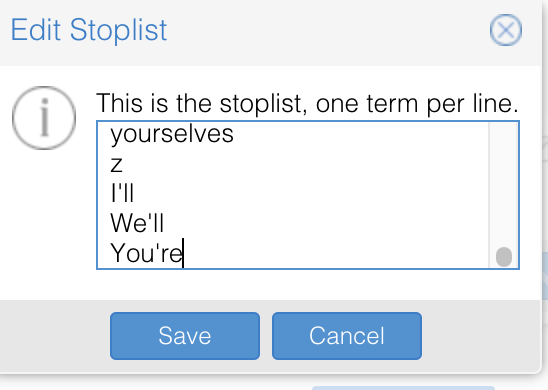
Another step I used was filtering out irrelevant words in the text, called a “stoplist”. Common transition words like “and” or “a” were removed by an option I checked off on the app. I was also able to input my own words into the stoplist. I stoplisted “I’ll”, “we’ll”, and “you’re”.
Visualization + Presentation
I was able to divide the txt file into ten equally sized parts and examine the word frequency in each part. The result was a bar graph that conveyed the usage of certain words over different parts of the piece.
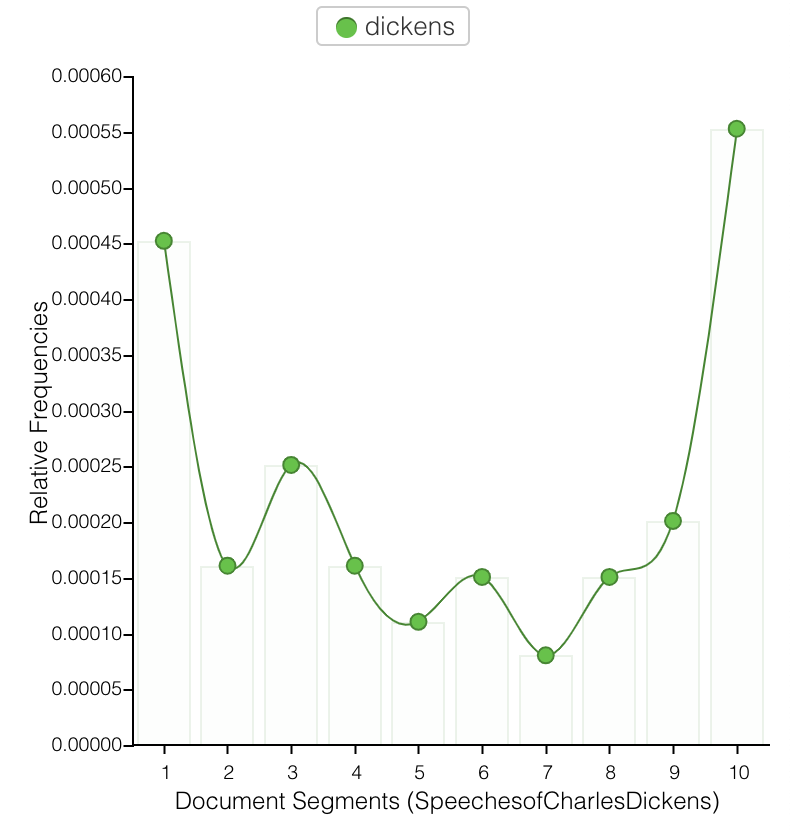
“gentlemen” followed the opposite trend, being decently common through all parts but exceedingly rare in the beginning and the end of the piece. As shown above, line graphs from VoyantTools can be embedded into WordPress, although I prefer screenshots because I think it looks better and the interactive element is not extremely important.
The most interesting part of my analysis was the word bubble presentation. Hovering your mouse over a word will highlight the most common words that follow it. For example, going to the word “Mr.” would highlight the word “Dickens”, as “Mr. Dickens” is a common title in the text. This is useful to see which words are often paired together.
The vast majority of other words had no significant trendline in either word bubbles or line graph format.
Significance
Textual analysis can be a potent tool for examining authorial choices, and some of them are noticeable. From the word bubbles, we can see that Dickens has a tendency to use formal phrases like “ladies and gentlemen”. And looking at word frequency, it’s clear Dickens covers topics like society, academia (via the word “institution”) and women. I think the biggest pitfall I had was the missed potential. The textual analysis could’ve been better with a single novel instead of a compilation of speeches. The compilation tells us about Dickens’ writing style in general, but an analysis of “A Tale of Two Cities” would’ve told us more in my opinion. Overall, while I enjoyed my findings from textual analysis as well as the program VoyantTools, I think there are better datasets to analyze than the one I chose to work with.

Leave a Reply